Materials knowledge · Engineering selection
Two groups, 18 classes or hundreds of grades? Each answer counts something different. This guide separates optical-design classes, chemical families and applications, then compares their indicative properties and uses in two clear tables.
This educational guide is not an inventory, supply, agency or performance claim for any listed grade. Check the specified manufacturer data and finished-part drawing before selection or processing.
1. Why do the counts differ?
Imaging glasses are grouped by refractive index nd, Abbe number νd and composition. Chemical families describe the glass network. Functional groups describe UV, IR, laser, filtering or substrate use. One material can occupy all three views, so 18 is not the total number of optical glasses. An ordinary transparent sheet also does not automatically meet optical-homogeneity, striae, bubble, stress or surface specifications.

2. The 18 traditional colourless optical-glass classes
GB/T 903-2019 is the current Chinese standard for colourless optical glass. The names and codes below follow the public CDGM optical-glass data sheet. A class is a naming and design starting point, not one composition; each class contains multiple grades. The property directions are only for screening. Confirm nd, νd, partial dispersion and internal quality for the actual grade.
| Code | Traditional class | Indicative optical direction | Typical design direction |
|---|---|---|---|
| FK | Fluor crown | Often lower relative dispersion; check the grade | Imaging lenses and chromatic pairing |
| QK | Light crown | Often lower relative dispersion; check the grade | Imaging lenses and chromatic pairing |
| K | Crown | Often lower relative dispersion; check the grade | Imaging lenses and chromatic pairing |
| PK | Phosphate crown | Often lower relative dispersion; check the grade | Imaging lenses and chromatic pairing |
| ZPK | Dense phosphate crown | Often lower relative dispersion; check the grade | Imaging lenses and chromatic pairing |
| BaK | Barium crown | Different index/dispersion combinations | Higher-index imaging and layout optimisation |
| ZK | Dense crown | Different index/dispersion combinations | Higher-index imaging and layout optimisation |
| LaK | Lanthanum crown | Different index/dispersion combinations | Higher-index imaging and layout optimisation |
| KF | Crown–flint | Design choices between crown and flint | Balance chromatic and other aberrations |
| QF | Light flint | Often higher relative dispersion; check the grade | Achromatic combinations and aberration control |
| F | Flint | Often higher relative dispersion; check the grade | Achromatic combinations and aberration control |
| BaF | Barium flint | Often higher relative dispersion; check the grade | Achromatic combinations and aberration control |
| ZBaF | Dense barium flint | Higher-index and/or higher-dispersion options; grade-specific | Compact lenses and chromatic correction |
| ZF | Dense flint | Higher-index and/or higher-dispersion options; grade-specific | Compact lenses and chromatic correction |
| LaF | Lanthanum flint | Higher-index and/or higher-dispersion options; grade-specific | Compact lenses and chromatic correction |
| ZLaF | Dense lanthanum flint | Higher-index and/or higher-dispersion options; grade-specific | Compact lenses and chromatic correction |
| TiF | Titanium flint | Higher-index and/or higher-dispersion options; grade-specific | Compact lenses and chromatic correction |
| TF | Special flint | Special design region; grade-specific | Specific optical-design requirements |
“Fluor crown” is not synonymous with bulk fluoride glass. Crown and flint are design categories, not two single chemical substances.
3. Sixteen representative chemical families: properties and uses
These 16 entries are a teaching framework, not an official international taxonomy, an exhaustive list or mutually exclusive groups. Boroaluminosilicates also sit within the broad silicate family; fluorophosphates are mixed systems. The table gives property directions, never a family-wide specification.
| Material family | Property direction and limits | Indicative applications |
|---|---|---|
| Fused silica / silica glass | Low expansion; UV/IR transmission depends on grade, impurities and OH | UV windows, laser optics, semiconductor processing |
| Silicate glass | Broad composition and index/dispersion range | Imaging, windows, industrial optics |
| Borosilicate glass | Some grades offer low expansion and thermal-shock resistance | Windows, substrates, microfluidics, MEMS |
| Aluminosilicate glass | Some compositions accept ion exchange; verify by grade | Protective covers, sensor windows |
| Boroaluminosilicate glass | Can be low-alkali or alkali-free; stability is grade-specific | Display and electronic substrates, packaging |
| Borate glass | Index and dispersion can be tuned by composition | Specialty optics and materials research |
| Phosphate glass | Can host rare-earth dopants; durability varies by formula | Laser gain media, specialty fibres |
| Borophosphate glass | Mixed network; optical, thermal and chemical properties can be tuned | Specialty functional-material research |
| Germanate glass | Some systems suit near/mid IR; range is composition-specific | IR photonics, specialty fibres |
| Tellurite glass | Some systems offer high index and nonlinear response | IR and nonlinear photonics |
| Heavy-metal oxide glass | High index is possible; check composition and compliance | High-index optics, specialty devices |
| Specialty aluminate glass | Unlike common silicates; properties depend on composition | Infrared-material research |
| Fluoride glass | Some grades suit IR; recheck mechanical and chemical limits | IR windows, specialty fibres |
| Oxyfluoride / fluorophosphate glass | Mixed oxide–fluoride systems; dispersion can be tailored | Low-dispersion optics, luminescent devices |
| Chalcogenide glass | Some compositions transmit IR; range and safety vary | Thermal imaging, IR spectroscopy and sensing |
| Oxynitride glass | Some systems have higher hardness and modulus | High-performance materials and specialty-optics research |
Silica glass is amorphous SiO₂, unlike crystalline quartz. “Alkali-free” means alkali-metal oxide content is controlled, not necessarily mathematically zero. Tellurite is an oxide glass and is not chalcogenide glass merely because it contains tellurium.
4. Which specifications decide suitability?
Similar names do not imply interchangeability. Record the measurement wavelength, sample thickness, temperature range, processed condition and acceptance method in the purchasing specification.
Refractive index nd
Index at the d spectral line near 587.6 nm; precision imaging also requires full dispersion data.
Abbe number νd
νd=(nd−1)/(nF−nC); F≈486.1 nm and C≈656.3 nm. A higher value generally means lower relative dispersion.
Spectral transmission
Distinguish external from internal transmittance; state wavelength, thickness and surface condition before comparing percentages.
Thermal expansion, CTE
State the temperature interval. Mixed-material packages also need bonding-process and thermal-budget checks.
Internal and finished quality
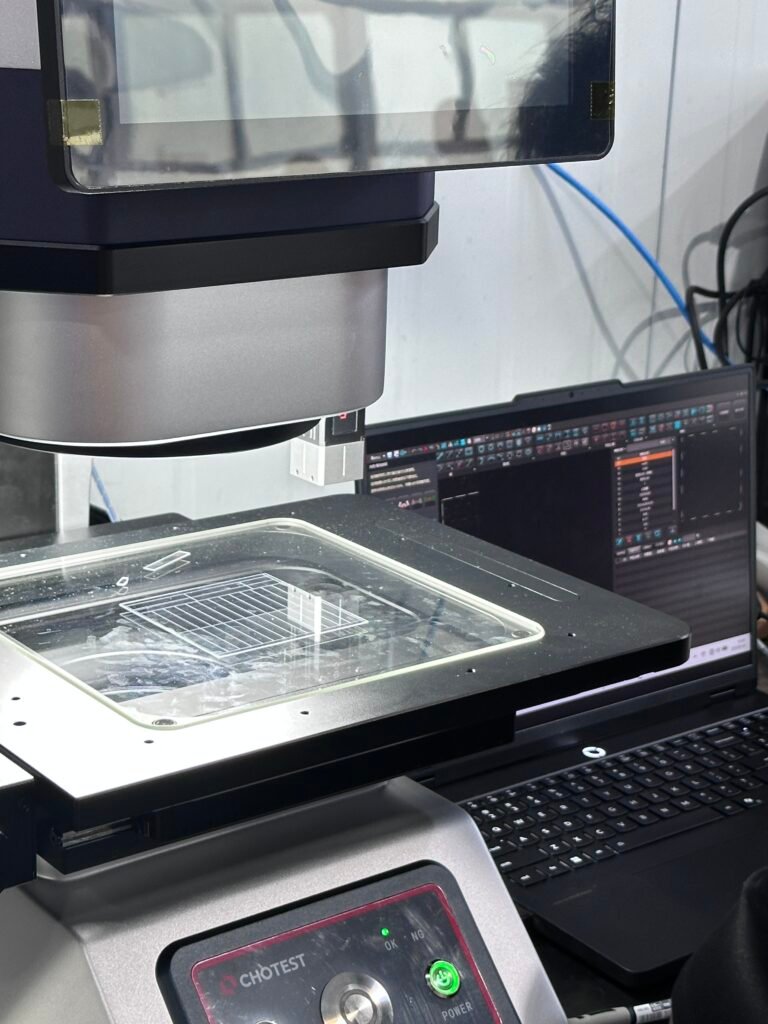
Specify homogeneity, striae, bubbles, stress birefringence, TTV, flatness, edge condition and cleanliness.
486.1 nmd
587.6 nmC
656.3 nm
5. Work back from the application and processing route
Imaging and instruments
Set wavelength, index, dispersion, homogeneity and stress limits.
Laser and UV windows
Check target-wavelength absorption, damage threshold, surface defects and coating.
Optical communications and sensing
Control dimensions, end faces, thermal matching and clean assembly.
Semiconductors and MEMS
Check CTE, thickness/TTV, cleanliness, dielectric data and bonding compatibility.
Microfluidics and infrared
Match chemical environment or IR band to material and channel/packaging processes.
6. What should a drawing-based RFQ include?
- Specified material grade or acceptable substitution criteria
- Operating wavelength, temperature and environment
- Dimensions, thickness, quantity and tolerances
- Surface quality, roughness, flatness, TTV and edge requirements
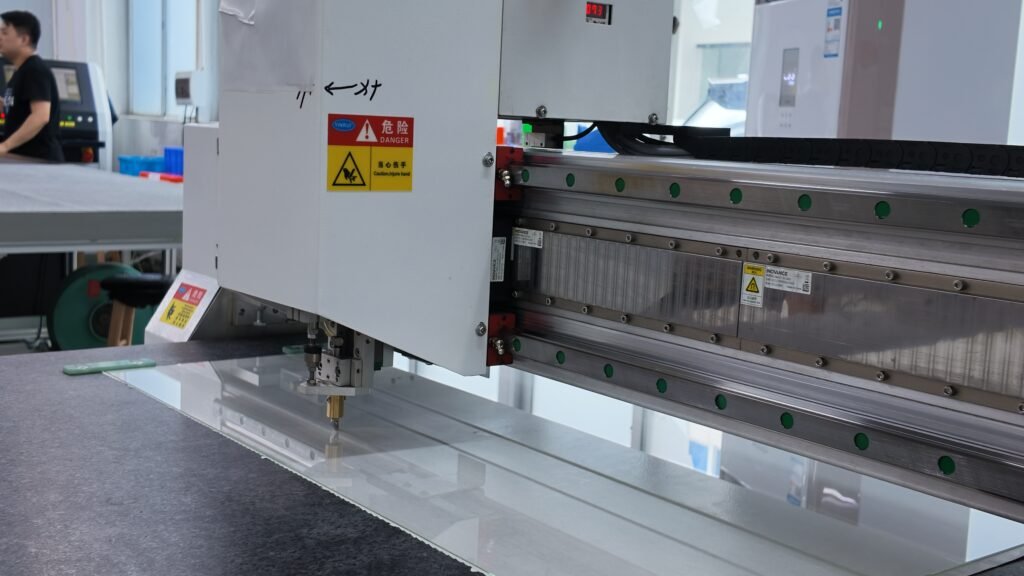
- Cutting, drilling, CNC, grinding, double-side polishing, cleaning and packaging
- Drawing revision, inspection standard and delivery schedule
Frequently asked questions
Are there really only 18 optical glasses?
No. Eighteen is one traditional classification of colourless imaging glass. Manufacturer catalogues contain many grades, and modern photonics includes additional chemical families.
Can two glasses with similar refractive index be substituted?
Not on index alone. Compare dispersion, operating-band transmission, expansion, chemical durability, internal quality and processing route.
Why is there no single spectrum for all glass?
Transmission depends on grade, thickness, surface condition and measurement method. A universal curve without those conditions would mislead.
Technical references
Classification, formulas and property directions were checked against the current standard, manufacturer information and peer-reviewed literature. Recheck the selected grade’s latest data before purchase or acceptance.
- GB/T 903-2019 — Colourless optical glass
- CDGM — current Optical Glass Data Sheet (18 classes)
- SCHOTT — Refractive Index and Dispersion (TIE-29)
- SCHOTT — Optical Glass Specifications
- OHARA — Optical Glass Type Designation
- Optica — Infrared Fiber Components
Need build-to-print optical glass processing?
Send the material grade, application, dimensions, quantity and drawing. We can review cutting, drilling, grinding, polishing and inspection against the selected material and finished-part requirements.
LIGHTING GLASS · Chen Chuangfeng · jerry-ton@lightingglass.cn · +86 13539645045