



PRECISION OPTICAL MATERIAL
K9 Optical Glass
Material selection and build-to-print processing for optical windows, prisms, lens blanks and substrates. Review the material, cutting, grinding, polishing and inspection plan against dimensions, thickness, surfaces and assembly requirements.
K9 Optical Glass: Material Characteristics
Select K9 material by considering both optical performance and the part drawing. Refractive index, Abbe number and transmission inform the optical design; thickness, outline, holes, slots, edges and surfaces determine the processing route and inspection plan.
The properties and curves on this page reference CDGM’s published H-K9L* data, glass code 517642. Confirm the full grade, material source and batch documents for the actual order.
K9 Selection Reference: Properties & Spectra
Reference grade: CDGM H-K9L*, second-base product. Values apply to the conditions stated in the manufacturer’s sheet.
| Property | Reference Value & Conditions |
|---|---|
| Reference grade / glass code | CDGM H-K9L* / 517642 |
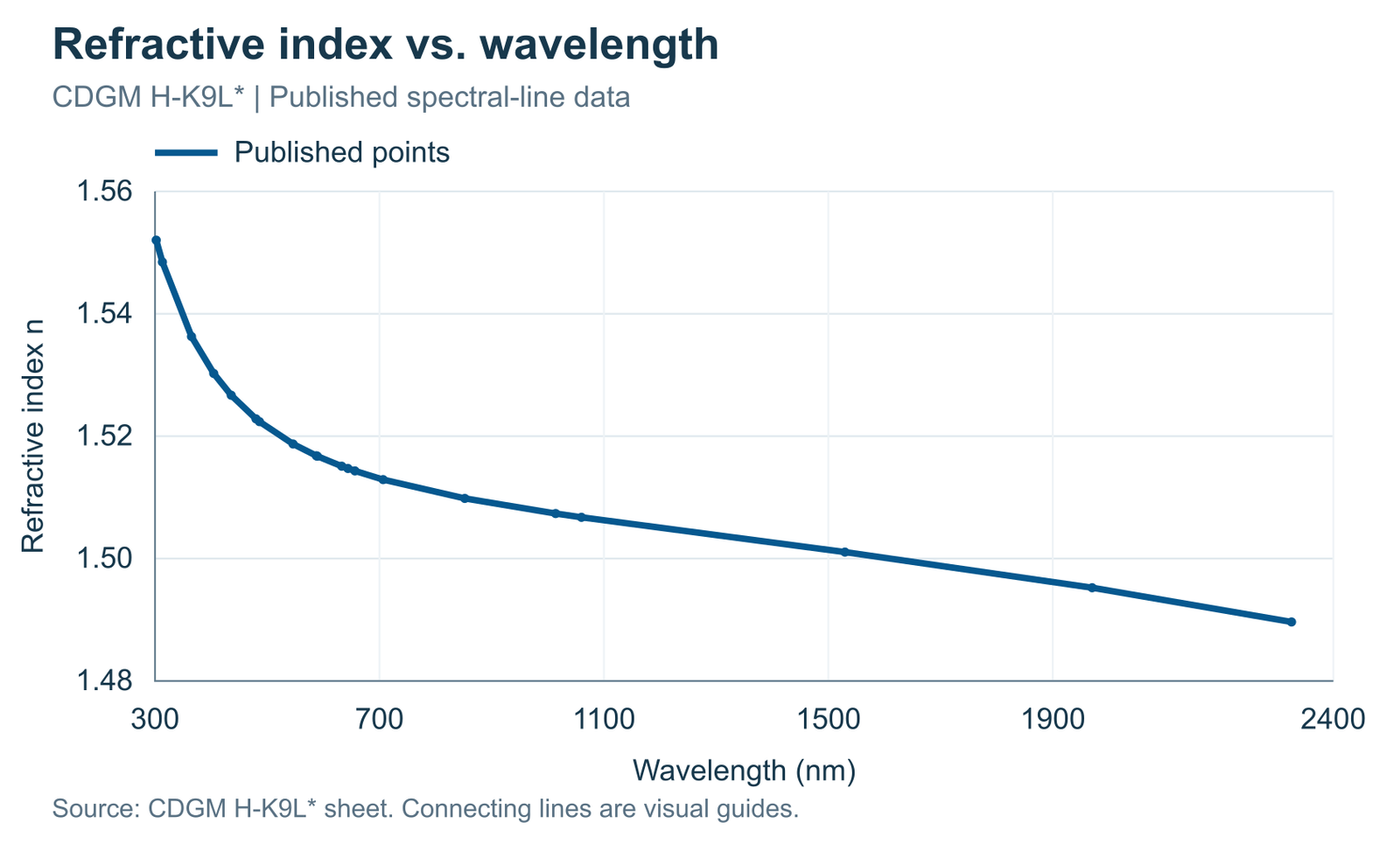
| Refractive index nd | 1.516800 (587.56 nm) |
| Abbe number νd | 64.20 |
| Mean dispersion nF − nC | 0.008050 |
| Density ρ | 2.52 g/cm³ |
| Linear CTE α (lower temperature interval) | 7.6 × 10⁻⁶ K⁻¹ (−30 to +70 °C) |
| Linear CTE α (higher temperature interval) | 9.5 × 10⁻⁶ K⁻¹ (+100 to +300 °C) |
| Transformation temperature Tg | 560 °C |
| Softening temperature Ts | 620 °C |
| Thermal conductivity λ | 0.943 W/(m·K) |
| Specific heat capacity cp | 0.692 J/(g·K) |
| Young’s modulus E | 79.2 GPa |
| Poisson’s ratio μ | 0.211 |
| Stress-optical coefficient B | 2.70 × 10⁻¹² Pa⁻¹ |
Properties are from the manufacturer’s sheet for the stated grade. Each thermal-expansion coefficient applies to its listed temperature interval. Tg and Ts are characteristic material temperatures, not operating-temperature limits. Delivery criteria follow the agreed specification and batch documents.
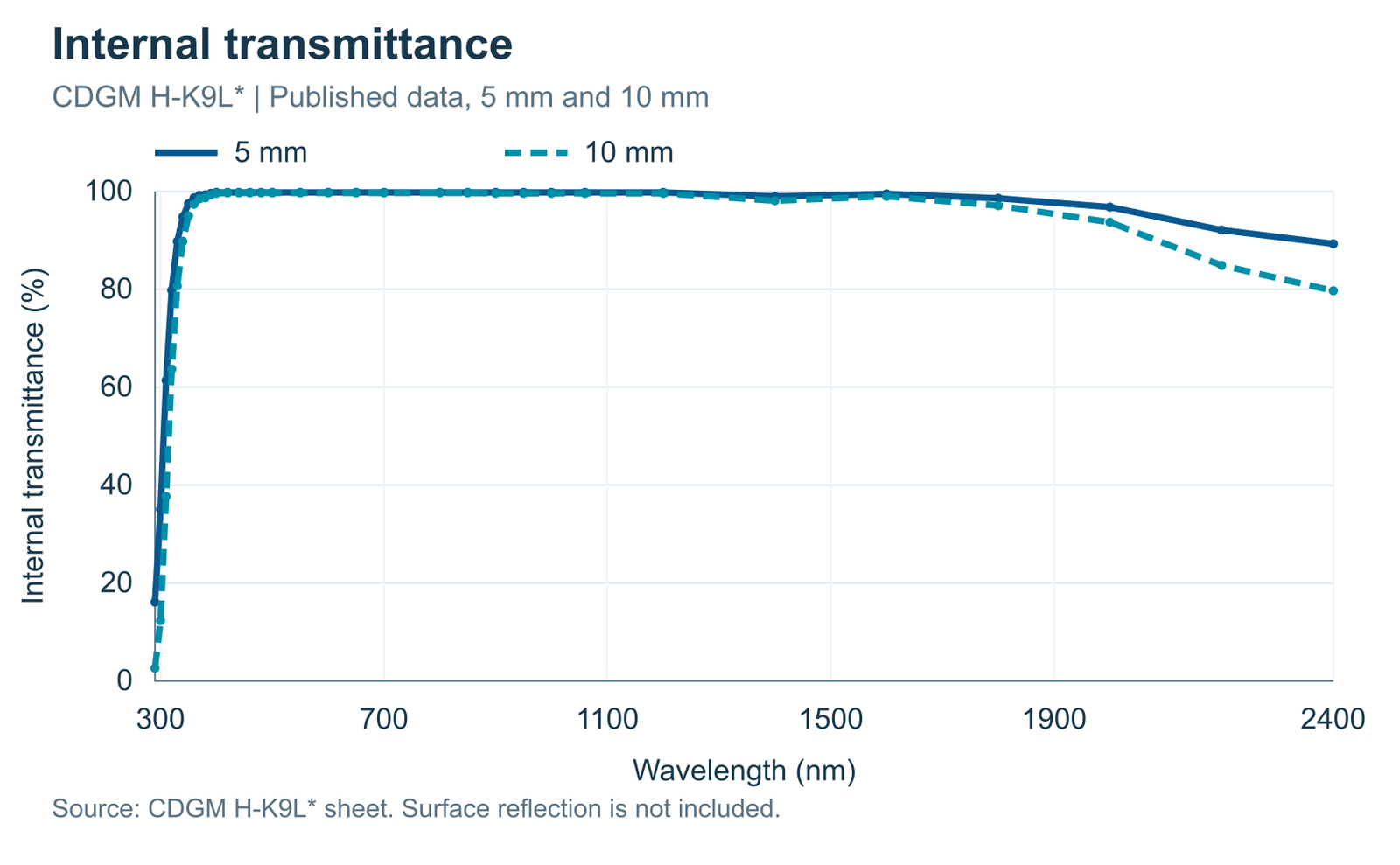
Internal Transmittance: 5 mm & 10 mm
Refractive Index vs. Wavelength
Selected Internal-Transmittance Data
| Wavelength (nm) | τ (5 mm) | τ (10 mm) |
|---|---|---|
| 350 | 97.5% | 95.0% |
| 400 | 99.8% | 99.6% |
| 550 | 99.8% | 99.7% |
| 1060 | 99.8% | 99.6% |
| 2400 | 89.3% | 79.7% |
K9 Material Ordering & Processing Specifications
Grade & Batch Requirements
Confirm the manufacturer, full grade, annealing and optical-quality requirements, together with the batch certificate or inspection records needed.
Dimensions, Thickness & Quantity
Provide the outline dimensions, thickness, holes or slots, datums, tolerances and quantity. Raw-material form, available sizes and lead time are confirmed for the project.
Surfaces & Acceptance Criteria
Specify the operating band, surface quality, figure, parallelism, TTV, coatings and packaging, and agree the inspection method and acceptance criteria.
From K9 Material to Build-to-Print Parts
Review precision cutting, CNC machining, drilling, edge finishing, grinding, polishing, cleaning and inspection against the drawing. Confirm thickness, outline, holes, slots, surface quality and acceptance methods before quotation; the process route and achievable tolerances are assessed for each project.
Applications to Evaluate for K9 Optical Glass
Evaluate K9 material for optical windows, prisms, lens blanks and coating substrates against the operating band, thickness and finished-part optical requirements. UV, near-infrared, high-power sources and large temperature changes require separate assessment of absorption, thermal stress and surfaces.
K9 Material & Processing FAQ
What Information Is Needed for a K9 Enquiry?
Provide the manufacturer or full grade, dimensions, thickness, quantity, application and drawing. For optical parts, specify the operating band, surface quality, figure, parallelism, TTV and inspection requirements. Include batch certificates or test records when material is already available.
Why Is Internal Transmittance Different from Finished-Part Transmission?
Internal transmittance describes loss within the material and excludes interface reflection. Finished-part transmission also depends on thickness, surface condition, coatings and incidence conditions.
How Should the Transformation and Softening Temperatures Be Used?
Tg and Ts are characteristic temperatures of the stated reference grade, not permitted continuous-service temperatures for a finished part. Evaluate operating temperature against load, heating and cooling rates, duration, geometry and mounting.
K9 Reference Data & Technical Documents
The source is CDGM’s published H-K9L* technical sheet. Internal-transmittance and refractive-index curves use the manufacturer’s tabulated points, not a LIGHTING batch test report. Source checked: 2026-10-16. Reconfirm data when the supplied grade or manufacturer’s documentation changes.
Send Your K9 Specification & Drawing
Send the material grade, dimensions, thickness, quantity, application and key acceptance criteria so we can review the material and processing plan.
Contact the Engineering Team →