

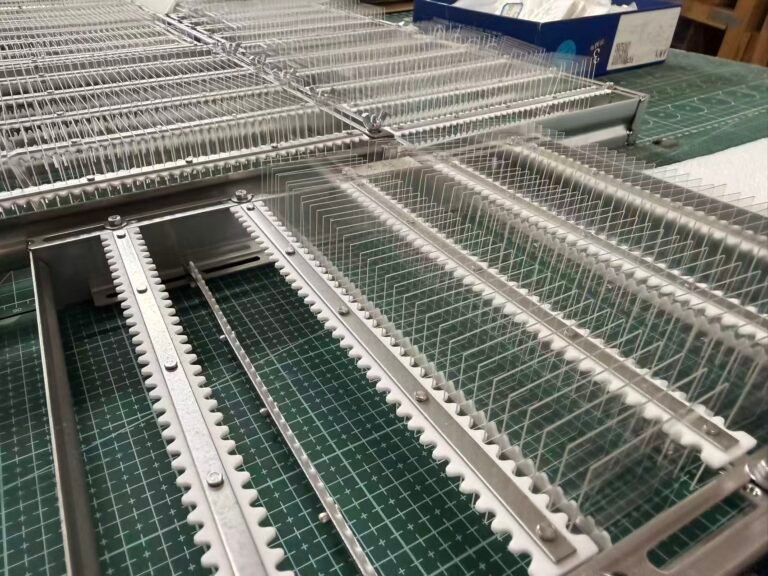
SCHOTT BOROFLOAT® 33 is often shortened to “BF33” or simply called borosilicate glass in a purchasing request. Neither shorthand is enough for a controlled drawing. Its thermal-use limits, characteristic temperatures, optical dispersion and chemical resistance answer different engineering questions.
This guide adapts the complete LIGHTING GLASS article originally published on our WeChat account. Material-specific figures are checked against SCHOTT's published technical information. They are reference properties, not inspection results or guaranteed performance of a particular finished part; confirm the supplied grade, thickness, lot documents and agreed test conditions.
1. What is BOROFLOAT® 33?
BOROFLOAT® 33 is SCHOTT's float-process borosilicate 3.3 sheet glass. The manufacturer describes it as the first borosilicate float glass and states that its composition and physical properties comply with DIN ISO 3585 and EN 1748 T1. “3.3” identifies a material class and low-expansion behavior; it is not permission to interchange products from different manufacturers without qualification.
SCHOTT's general information gives approximate oxide fractions of 81% SiO₂, 13% B₂O₃, 4% Na₂O/K₂O and 2% Al₂O₃. These are published composition references, not a certificate of analysis for a delivered lot. Request lot-specific documentation if traceability is required.
2. Thermal properties: five temperatures with five different meanings
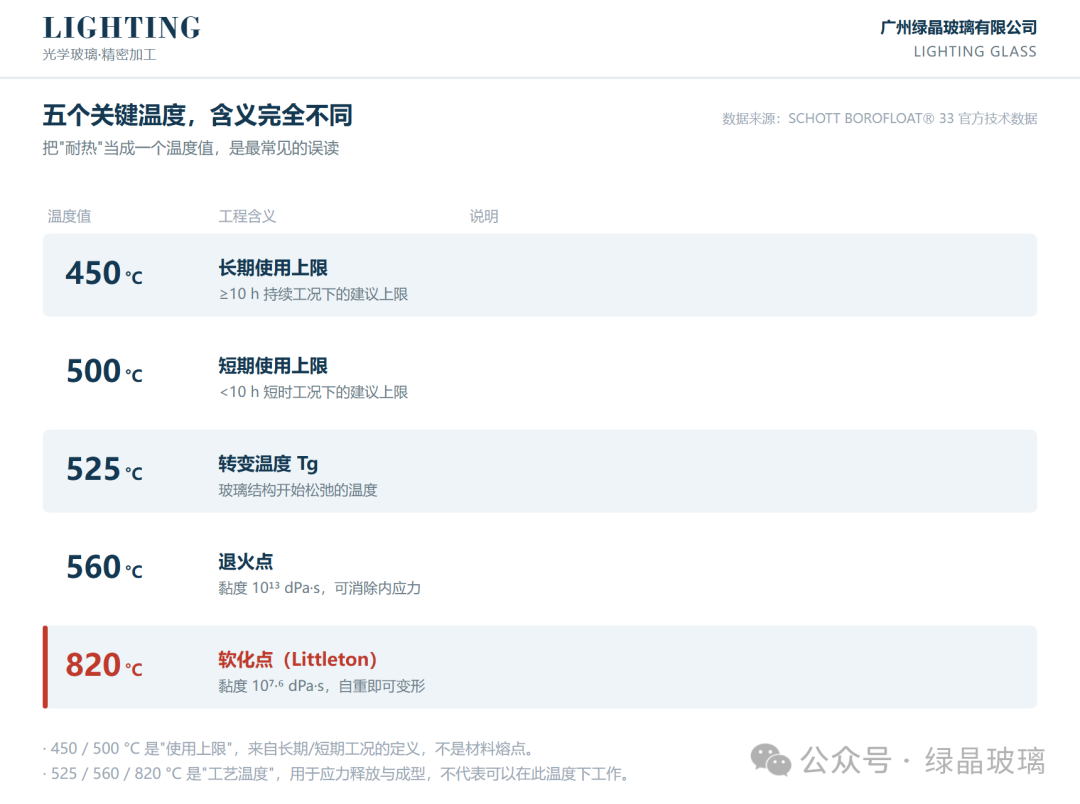
A single “heat-resistance temperature” conceals important distinctions. Long- and short-term limits refer to use conditions. Transformation, annealing and softening temperatures describe changes in glass structure or viscosity; none is a blanket service-temperature rating for a finished assembly.
| Temperature | Published meaning | Engineering interpretation |
|---|---|---|
| 450 °C | Long-term use, ≥ 10 h | Manufacturer's material reference limit; also evaluate geometry, load, thermal gradients and mounting. |
| 500 °C | Short-term use, < 10 h | Not a continuous operating temperature. |
| 525 °C | Glass transformation temperature Tg | A characteristic material temperature, not a service limit. |
| 560 °C | Annealing point at 1013 dPa·s viscosity | A processing reference; an actual annealing cycle must be designed for the part. |
| 820 °C | Littleton softening point at 107.6 dPa·s viscosity | Deformation becomes significant; this is emphatically not an 820 °C operating rating. |
Always state the measurement conditions for other thermal values: mean linear expansion is 3.25 × 10⁻⁶ K−1 over 20–300 °C (ISO 7991); thermal conductivity is 1.2 W/(m·K) at 90 °C; and specific heat capacity is 0.83 kJ/(kg·K) over 20–100 °C. These are not a single, all-temperature guarantee.
For broad context, common soda-lime glass is often around 9 × 10⁻⁶ K−1, roughly 2.8 times the BOROFLOAT® 33 reference value. Recalculate any actual alternative from its specified grade and the same temperature interval rather than designing from a general comparison graphic.

3. Optical properties: low dispersion does not mean transmission at every wavelength
SCHOTT reports a refractive index nd of 1.47140 at 587.6 nm, an Abbe number νe of 65.41, dispersion nF − nC of 71.4 × 10⁻⁴, and stress-optical coefficient K of 4.0 × 10⁻⁶ mm²/N. Optical design requires the value at the intended operating wavelength; the 587.6 nm value cannot stand in for the entire spectrum.
| Wavelength λ | Reference index n | Wavelength λ | Reference index n |
|---|---|---|---|
| 435.8 nm | 1.48015 | 589.3 nm | 1.47133 |
| 479.9 nm | 1.47676 | 643.8 nm | 1.46953 |
| 546.1 nm | 1.47311 | 656.3 nm | 1.46916 |

BOROFLOAT® 33 transmits well in the visible range and can serve selected near-UV and near-IR uses, but “transparent” never means high transmission at all wavelengths or all thicknesses. The UV edge is particularly thickness- and impurity-dependent. Specify the wavelength band, glass thickness, transmission definition and test method, then request the applicable curve or sample measurements.
4. Chemical, mechanical and electrical properties
The manufacturer's chemical-resistance classifications are hydrolytic HGB 1 (ISO 719) and HGA 1 (ISO 720), acid class 1 (DIN 12116), and alkali class A 2 (ISO 695 / DIN 52322). Good chemical durability is not unlimited resistance to strong alkalis, hot cleaning baths or every process fluid.
| Property | Published reference and condition | Property | Published reference and condition |
|---|---|---|---|
| Density | 2.23 g/cm³ at 25 °C | Young's modulus | 64 kN/mm², DIN 13316 |
| Poisson's ratio | 0.20 | Knoop hardness | 480, HK0.1/20 |
| Bending strength | 25 MPa, DIN 52292 T1 | Dielectric constant | 4.6 at 1 MHz and 25 °C |
| Dielectric loss tangent | 37 × 10−4 at 1 MHz and 25 °C | Alkali-resistance class | A 2, ISO 695 |

5. Selection boundaries versus soda-lime glass and fused silica
No glass family is best without an application. Soda-lime glass is commonly economical and widely processed. Fused silica is often selected for more demanding low-expansion or UV requirements. BOROFLOAT® 33 balances low expansion, visible transmission, chemical durability, float-sheet availability and processability. Values vary by grade and manufacturer; a family-level comparison is not a substitution approval.
| Evaluation | BOROFLOAT® 33 | Common soda-lime glass | Fused silica |
|---|---|---|---|
| Approximate CTE, × 10−6 K−1 | 3.25 over 20–300 °C | About 9; grade and interval dependent | About 0.55; grade and interval dependent |
| Typical selection emphasis | Balance of thermal, optical and chemical needs | Conventional isolation and cost-sensitive uses | Very low expansion or specified UV optics |

6. Typical application areas
- Optics and displays: optical windows, filter substrates, mirror substrates and cover glass; specify band, thickness, surface condition and clear aperture.
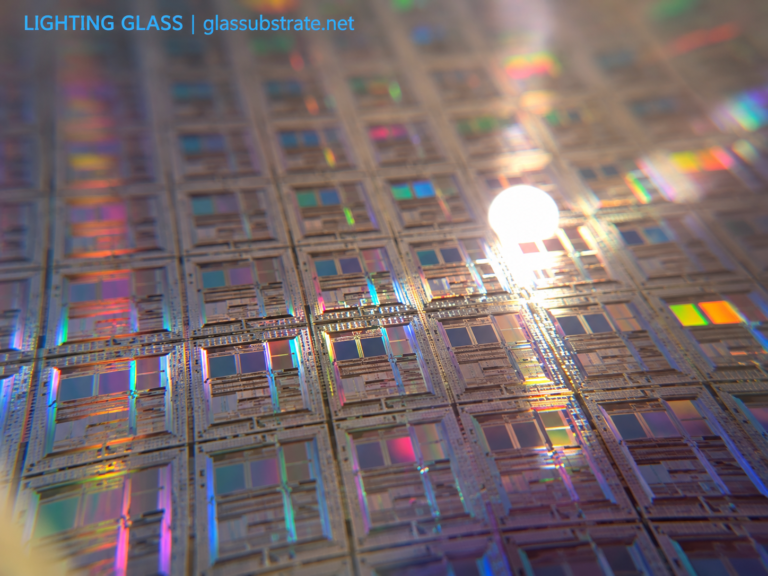
- Semiconductors and microelectronics: MEMS caps, glass wafers, sensor-packaging substrates and insulating parts; evaluate dimensions, cleanliness and the downstream bonding process.
- Chemical and pharmaceutical equipment: viewing windows, sight glasses and laboratory components; confirm the medium, temperature, pressure and seal design.
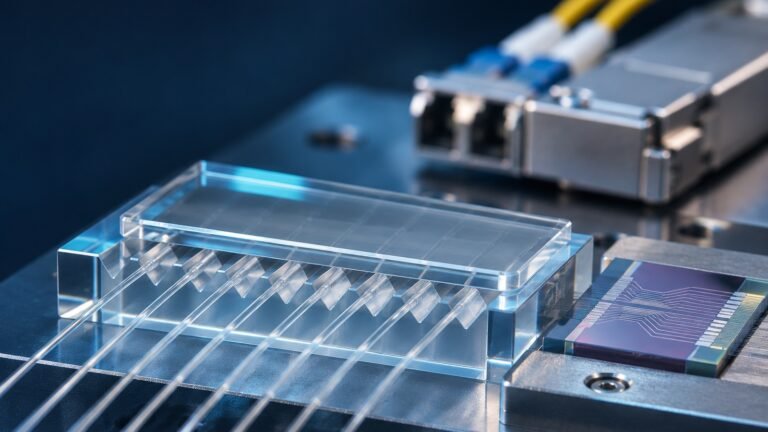
- Optical communications: V-groove substrates and optical-module windows; define tolerances, edge finish and optical requirements.
- Lighting and photovoltaics: heat-exposed protective sheets and cover components; assess the installed assembly and thermal cycling.
7. Four processing requirements that are easy to overlook
Cutting and edge finish
Edge chips and microcracks can affect performance under thermal cycling or mechanical load. A drawing should define allowable chipping, chamfer, edge condition and inspection method rather than merely asking for “smooth edges.”
Holes, slots and stress concentration
Openings and notches change local stress. For laser or CNC features, assess diameter, spacing, minimum edge distance, thickness and final assembly from the drawing. The glass grade alone cannot justify a machining-limit promise.
Residual stress and annealing
Some thermal or machining routes may introduce residual stress. The 560 °C annealing point is a material datum, not a universal annealing recipe. Whether to anneal, the dwell and cooling profile, and stress inspection depend on part geometry and actual equipment.
Mounting method
Rigid clamping, local temperature differences and mismatched frame expansion can add stress to glass. Support points, clearance, interface pads, load and cycling belong in the material-selection review.
8. Four common misconceptions
| Claim | Better interpretation |
|---|---|
| “Borosilicate” automatically means BF33. | It is a broad material description; specify the exact grade and applicable standard. |
| Its softening point is 820 °C, so it can operate at 820 °C. | The softening point is a processing characteristic. Published long- and short-term use references are 450 °C and 500 °C, respectively. |
| BF33 is transparent across the whole spectrum. | Transmission depends on wavelength, thickness and material condition; request the relevant curve for UV or IR work. |
| Chemical resistance means compatibility with every medium. | Alkali resistance is only class A 2; assess strong or hot alkalis and special fluids individually. |
9. What should a purchasing RFQ include?
- The exact material grade and standard, such as BOROFLOAT® 33, not simply “borosilicate glass.”
- A controlled drawing: dimensions, thickness, tolerances, holes or slots, edge finish and allowable chipping.
- Optical conditions: working band, transmission or index requirement, sample thickness and test method.
- Service conditions: maximum temperature, thermal cycling, load and contacting chemicals.
- Documents required at delivery: material certificate, lot traceability and mutually agreed finished-part inspections.
BOROFLOAT® 33 is useful because of its balanced property set. Understanding the boundary of the material and the finished assembly matters more than remembering one “heat-resistance” number. LIGHTING GLASS can review drawings for glass supply, precision cutting, holes and slots, edges, surface finishing and inspection; any process route and acceptance limit are subject to drawing review and quotation.
Send drawings and specifications: jerry-ton@lightingglass.cn; phone / WeChat: +86 13539645045. Contact us with your requirements →
Data basis: SCHOTT BOROFLOAT® technical details, technical data sheet and general information. Manufacturer reference values do not replace the certificate or inspection criteria for a particular delivered lot.